


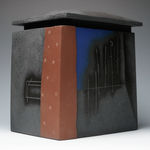
Hayashi Yasuo 林康夫 Japanese, b. 1928
H29.5 × W26 × D22.3 cm
Further images
-
(View a larger image of thumbnail 1
)

-
(View a larger image of thumbnail 2
)

-
(View a larger image of thumbnail 3
)
-
(View a larger image of thumbnail 4
)

-
(View a larger image of thumbnail 5
)

-
(View a larger image of thumbnail 6
)

-
(View a larger image of thumbnail 7
)

-
(View a larger image of thumbnail 8
)

-
(View a larger image of thumbnail 9
)

-
(View a larger image of thumbnail 10
)

-
(View a larger image of thumbnail 11
)

-
(View a larger image of thumbnail 12
)

-
(View a larger image of thumbnail 13
)

Born in 1928, Hayashi belongs to the first generation of artists who shaped contemporary Japanese ceramics after the war. As a young man, he was drafted as a kamikaze pilot; the sudden end of the war spared his life and returned him to Kyoto. Through family connections in Kyoto’s cultural circles, he associated with leading artists of the time, including Isamu Noguchi (1904-1988), and remarkably, he exhibited with Noguchi in 1947 in Paris, while still very young. In November of that same year, he was one of the inaugural founding members of the first avant-garde sculptural ceramic movement called "Shiko-kai" in Kyoto, holding the very first exhibition of ceramic "Objets" or "Obuje-yaki," a term that referred to ceramic objects that subverted the Japanese tradition of ceramic vessel art.
Hayashi never apprenticed in a traditional ceramic lineage. Instead, he developed his own methods through disciplined experimentation. Working closely Hayashi Teruko 林 照子, his wife and steadfast partner in both life and practice, Hayashi built his sculptures using coiled clay strips, gradually forming dense, architectural volumes of extraordinary precision, before applying various skillful surface applications such as white engobe and thereafter bisque firing.
His surfaces are equally compelling. Glaze is blown onto the clay, creating layered optical effects that shift with light and movement. His works are not only three-dimensional; they speak directly to the senses as experiential objects, thus resisting easy photography and demanding physical presence.
Formally, his later work after 1990's began exploring architecture as a cornerstone in his form:
When the German architect Bruno Taut (1880–1938) visited Japan, he described the traditional house not as an object, but as a way of living, “a stage in an open-air theatre,” with nature as its backdrop.
Taut was referring to the machiya, wooden townhouses that emerged in the 12th century and remain central to Hayashi Yasuo’s work. Drafted as a teenage pilot during WWII, Hayashi flew night training missions over Kyoto, encountering the city as a vast field of kyōmachiya roofs sprawling with life below him.
Seen from the air, both distance and darkness transformed these homes into ambiguity. This altered perception—paired with an unquestionable confrontation with death—left a deep psychological impact. Through his continued exploration of kyōmachiya forms, Hayashi reflects on the importance of humanity, memory, and the essential value of life.


