


Hayashi Yasuo 林康夫 Japanese, b. 1928
H30.2 × W31.5 × D16 cm
Further images
-
(View a larger image of thumbnail 1
)
-
(View a larger image of thumbnail 2
)
-
(View a larger image of thumbnail 3
)
-
(View a larger image of thumbnail 4
)

-
(View a larger image of thumbnail 5
)
-
(View a larger image of thumbnail 6
)
-
(View a larger image of thumbnail 7
)
-
(View a larger image of thumbnail 8
)
-
(View a larger image of thumbnail 9
)
-
(View a larger image of thumbnail 10
)
-
(View a larger image of thumbnail 11
)

-
(View a larger image of thumbnail 12
)

-
(View a larger image of thumbnail 13
)
-
(View a larger image of thumbnail 14
)
-
(View a larger image of thumbnail 15
)
-
(View a larger image of thumbnail 16
)
Born in 1928, Yasuo Hayashi is one of the pivotal figures of Japan’s first postwar generation of ceramic artists, whose experiments helped define the course of contemporary Japanese ceramics. Drafted as a kamikaze pilot while still a young man, Hayashi was spared by the abrupt end of the Second World War and returned to Kyoto. He initially took over the studio of his father, a painter, and began his own artistic career in painting before turning to ceramics in the immediate postwar years.
Moving within Kyoto’s vibrant artistic circles, Hayashi formed relationships with many of the period’s leading cultural figures, including Isamu Noguchi 野口 勇 (1904–1988). Remarkably, while still at the beginning of his career, Hayashi exhibited alongside Noguchi in Paris in 1947.
In November of that year, Hayashi became one of the founding members of Shiko-kai 四耕社, Kyoto’s first avant-garde movement devoted to sculptural ceramics. The group’s inaugural exhibition presented ceramic objets, also known as obuje-yaki—works conceived as autonomous sculptural forms rather than functional vessels. In doing so, the artists consciously challenged the vessel-based traditions that had long shaped Japanese ceramic practice.
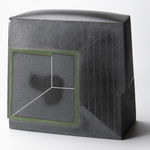
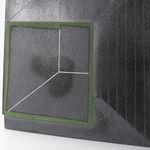
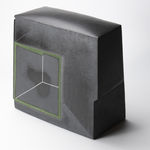
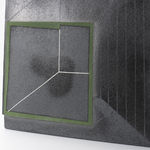
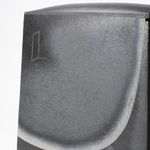
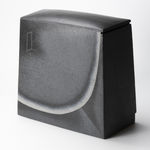
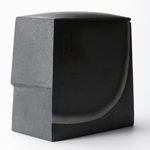
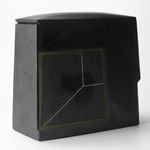
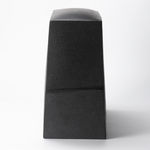
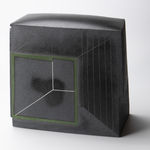
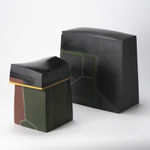
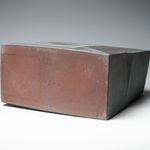
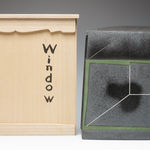
This abstract work exemplifies Hayashi’s sustained investigation into the relationship between object and space, particularly the ways in which depth, light, and perspective can destabilize spatial perception. Its form also evokes the architecture of Kyoto’s traditional machiya townhouses, transforming familiar architectural elements into an enigmatic meditation on constructed space.
As the art critic Toru Takahashi observed:
“The recent work of Yasuo Hayashi often makes it difficult—sometimes even impossible—to determine from photographs how the works are constructed. Which elements project forward and which recede—the very organization of space—is frequently difficult to read in an image alone. When encountered in person, however, under good light and from multiple viewpoints, and with an awareness of their material texture, the works generate complex optical illusions that alter our perception of their three-dimensional construction. These effects become even more pronounced in photographs with a limited tonal range. Hayashi constructs such experiences so skillfully that one might suspect he takes particular pleasure in creating forms that resist photographic representation. His work reveals clear evidence of an elaborate and deliberate calculation of these visual effects.”
Translated excerpt from “Space of Ceramics in the Works of Yasuo Hayashi,” by art critic Toru Takahashi, in The Works of Yasuo Hayashi (1998), published with the support of the Tsukamoto Educational Institute Grant-in-Aid, no. 12.